fanless vs fanned mini pcs

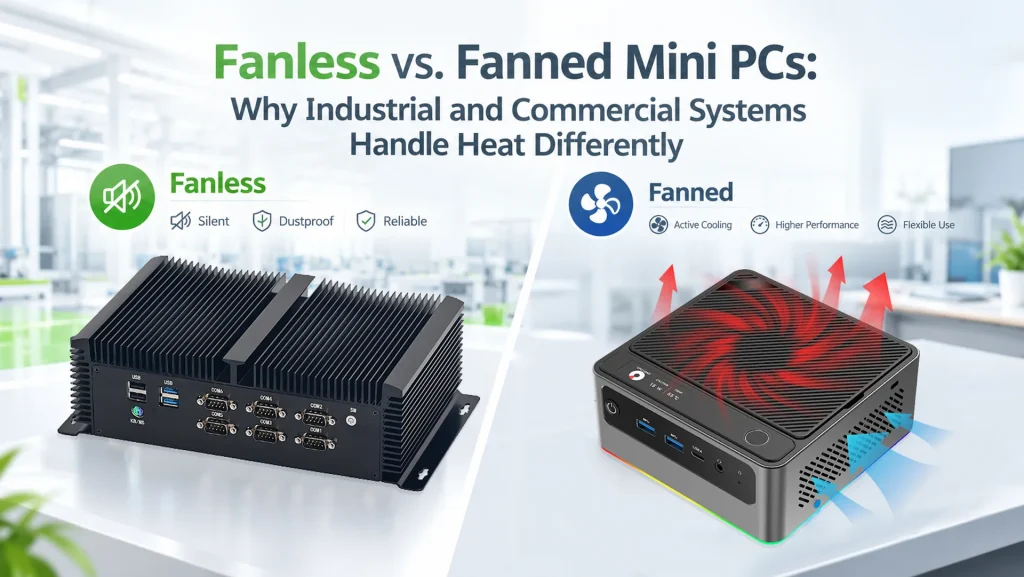
Fanless vs. Fanned Mini PCs: Why Industrial and Commercial Systems Handle Heat Differently

Key Comparison Summary

Industrial Mini PC: Reliability First. Sacrifices high peak performance in favor of a fanless, fully sealed, passively cooled architecture. Built to endure harsh environmental conditions and 24/7 non-stop operations.

Commercial Mini PC: Performance & Cost First. Sacrifices extreme ruggedness and longevity in favor of an active, fan-cooled setup. Built to handle heavy computing tasks in gentle environments and intermittent usage cycles.

Why Industrial Mini PCs are Almost Exclusively Fanless (Passive Cooling)

Industrial Mini PCs intentionally ditch mechanical fans. The core philosophy is to prioritize maximum stability in extreme environments and ensure long-term, maintenance-free operation. While this sacrificial design limits peak computational performance, it perfectly adapts the hardware to harsh industrial conditions for four critical reasons:

Why Commercial Mini PCs Widely Feature Fans (Active Cooling)

Commercial Mini PCs prioritize the balance between high performance, cost-efficiency, and daily user experience. Because their operational environments are mild and do not require extreme ruggedness, they utilize highly efficient active air-cooling solutions. The core reasons include:

China computer manufacturer
10
01. Eliminating Fatal Failures in Harsh Environments
Industrial settings are often plagued by dust, oil mist, moisture, constant vibrations, and extreme temperature fluctuations. A cooling fan is a precise mechanical moving part. Over prolonged operation, it continuously sucks in dust and grease, which clogs cooling ducts and glues core hardware together—ultimately leading to thermal failure and system crashes. Furthermore, constant equipment vibration can easily damage fan bearings, causing annoying noise or complete stoppage.
A fanless design completely eliminates this point of failure. With zero moving parts, the entire system delivers significantly enhanced vibration resistance, dustproof, and waterproof capabilities, making it ideal for assembly lines, control cabinets, and outdoor equipment.
01. Handling the Thermal Pressure of Higher Compute Power
Commercial systems are designed for office work, multimedia playback, light content creation, and multitasking. They frequently pack 45W to 65W (or higher) Intel Core or AMD Ryzen processors, which generate high burst power and significant heat.
 
Relying solely on passive cooling would result in heat accumulation, thermal throttling, and lagging, preventing the hardware from unleashing its full performance. An internal whisper-quiet fan rapidly evacuates high temperatures, guaranteeing peak performance stability under heavy workloads.
02. Meeting the Demands of 24/7 Uninterrupted Operation
The core requirement for industrial hardware is ultra-long standby and zero-downtime fault tolerance. Many industrial control hosts must run continuously for years without shutting down.
Mechanical fans have a finite lifespan; long-term high-speed rotation inevitably leads to wear, aging, and eventual failure. If a fan breaks down, the sudden thermal collapse can paralyze entire production lines or monitoring systems, causing catastrophic financial losses. Passive fanless cooling suffers no lifespan degradation, resulting in a Mean Time Between Failures (MTBF) far superior to fanned models, perfectly matching the needs of unmanned, long-term industrial monitoring.
02. Friendly Operating Environments with High Fault Tolerance
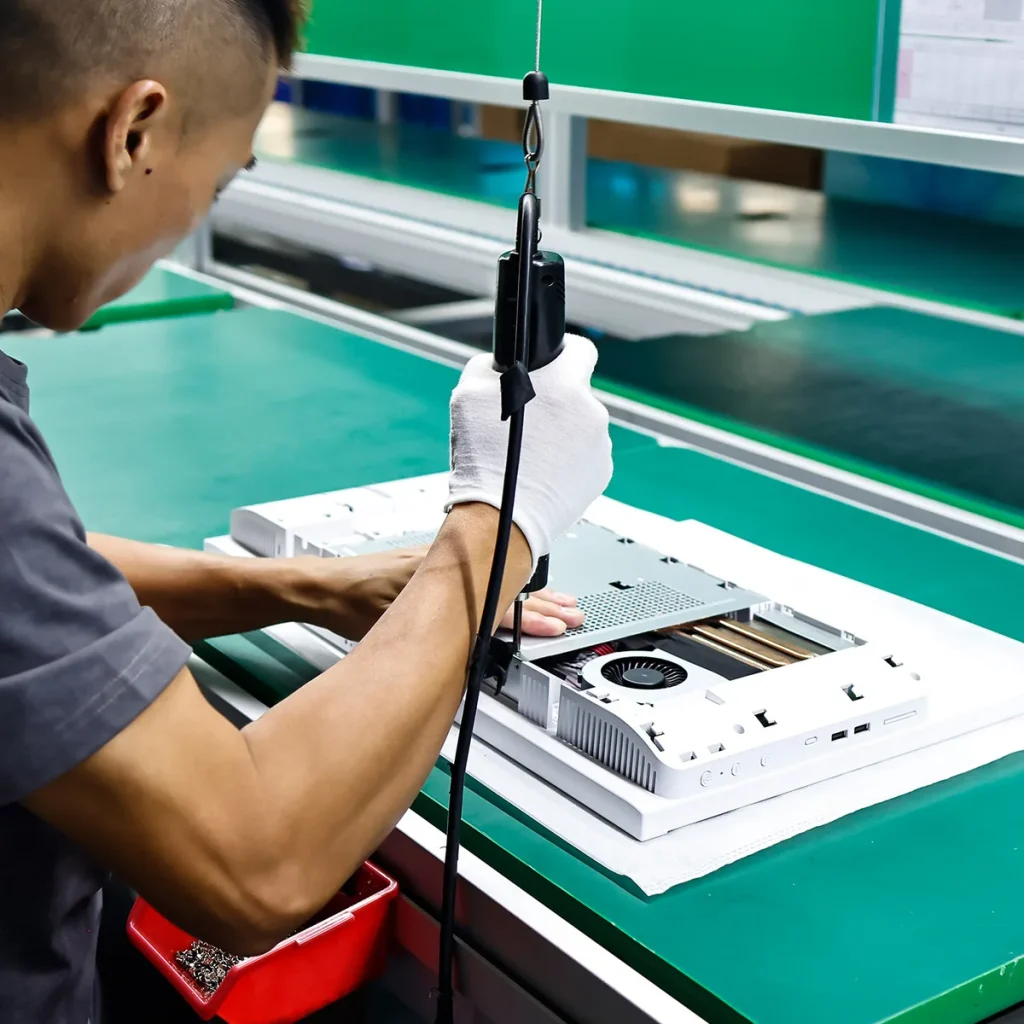
Commercial devices operate in gentle environments like offices and homes, which are clean, temperature-controlled, and vibration-free. Dust and oil contamination are rarely a concern here.
 
Even if a fan accumulates dust or undergoes minor wear after years of use, it usually just results in a bit of noise or a slight drop in cooling efficiency rather than killing the entire PC. Users can also easily perform routine cleaning and maintenance, meaning the impact of a minor fan fault is exceptionally low.
China computer manufacturer
OEM computer manufacturer
03. Specialized Thermal Design for Low-Power Hardware
Industrial Mini PCs do not chase extreme processing power. Instead, they typically feature 15W to 35W low-power processors, which offer more than enough compute capacity for data collection, protocol conversion, equipment control, and edge computing.
The entire chassis is constructed from heavy-duty aluminum alloy integrated with copper heat pipes. The computer shell effectively acts as a giant heatsink, evenly conducting heat away from the CPU and GPU to the outer ridges. This passive thermal architecture completely satisfies the cooling requirements of low-power hardware without needing an auxiliary fan.
03. Optimizing Manufacturing Costs and Chassis Thickness
A truly fanless PC requires a massive, thickened aluminum alloy chassis and custom-engineered heat pipe structures, which drives up material and manufacturing costs while making the device bulkier.
 
In contrast, an active fan structure is mechanically simple, cost-effective, and highly efficient at dispersing heat. It allows manufacturers to maintain excellent thermal performance within a lightweight, ultra-thin footprint, perfectly aligning with the lightweight, high-cost-performance positioning of commercial products.
04. Fully Sealed Chassis Tailored for Industrial Installation Space

Industrial PCs generally feature fully or semi-sealed structures without any open ventilation slots. This design prevents dust and moisture from entering while allowing the PC to be safely embedded into tight, unventilated spaces like enclosed industrial control cabinets. Conversely, active fan cooling requires open vents, which breaks the chassis seal and fails to meet strict industrial ingress protection (IP) standards.

04. No Requirement for Extreme Fault-Free Longevity
Commercial computers do not need to stay powered on 24/7. Users typically shut them down at the end of the day, drastically slowing down the wear and tear on the internal fan.
Even in the rare event of a fan failure, replacing it is incredibly inexpensive and straightforward. It does not trigger major disruptions at the production or operational levels, making it perfectly suited for the rhythm of enterprise and consumer workflows.

Contact Us For Bulk Wholesale & OEM Quotes:

Ready to expand your product catalog or secure hardware for your next large-scale project? We offer competitive volume discounts and dedicated technical support.

Scan the code