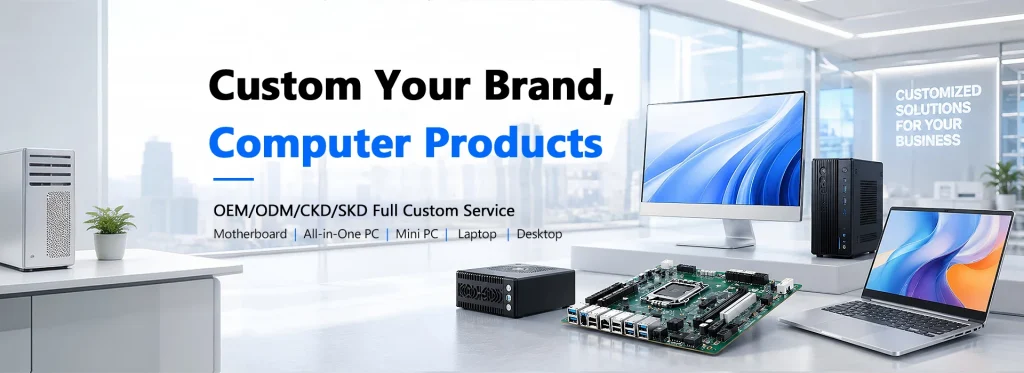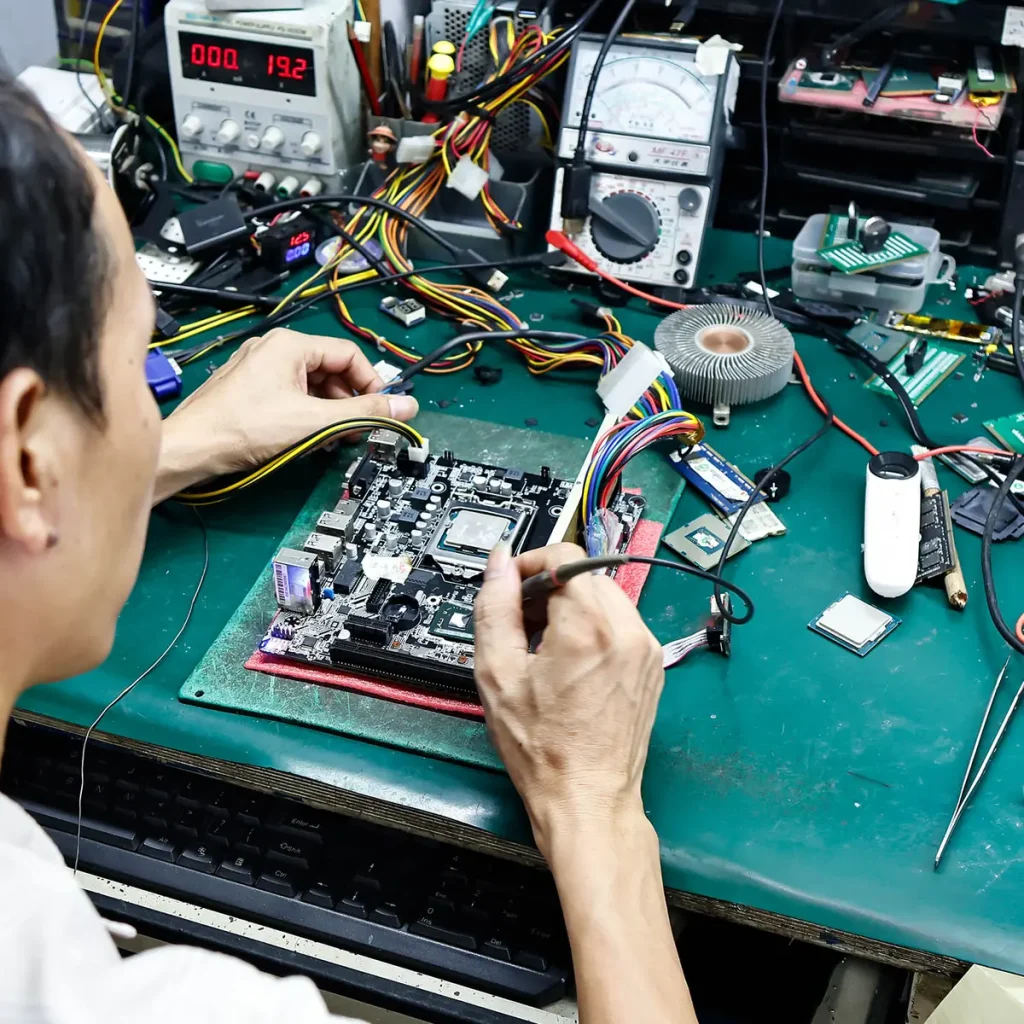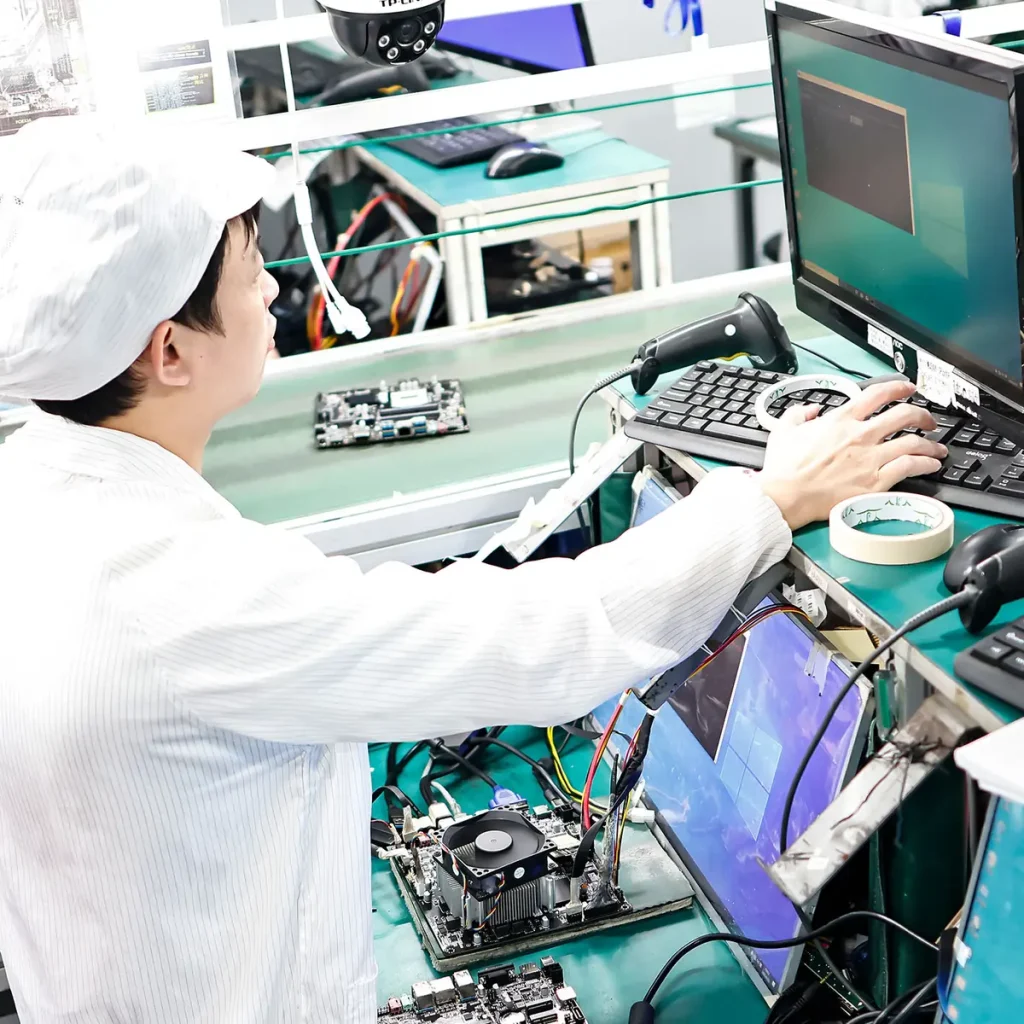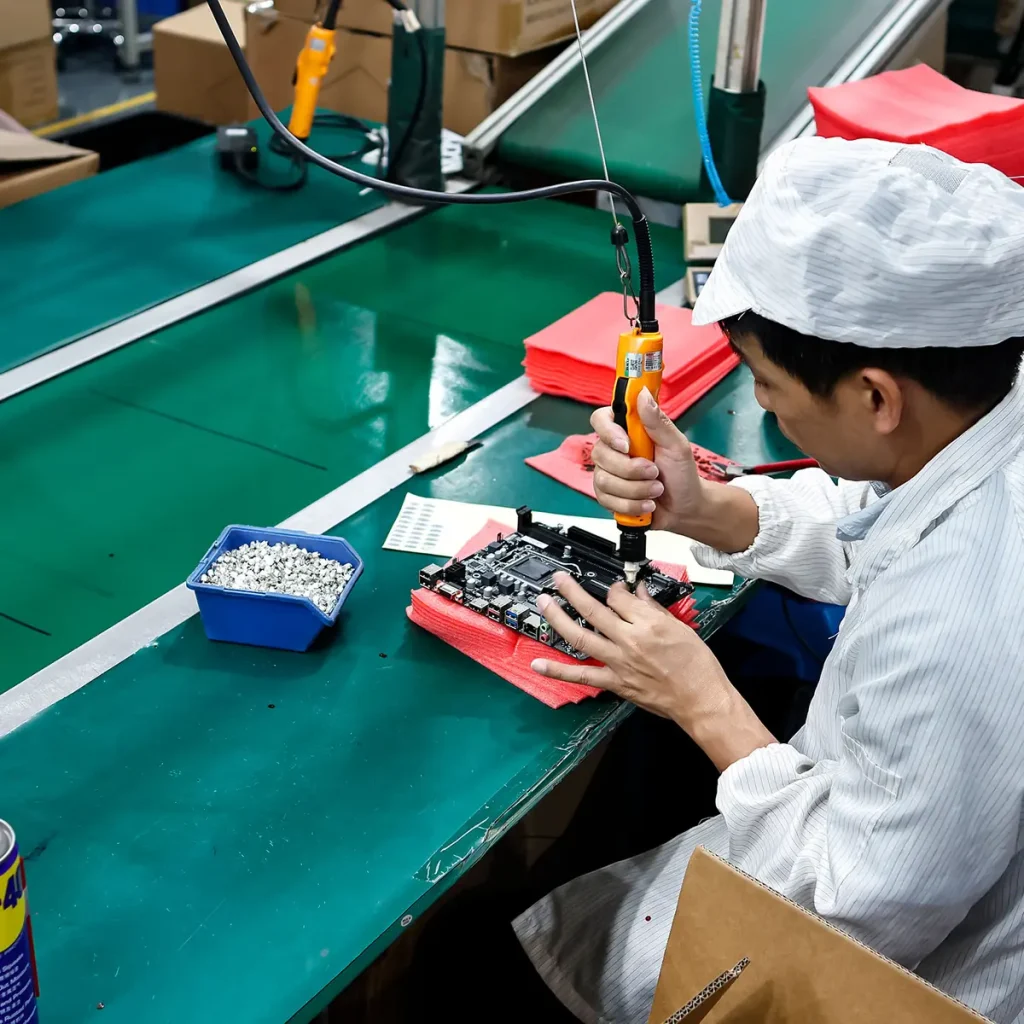
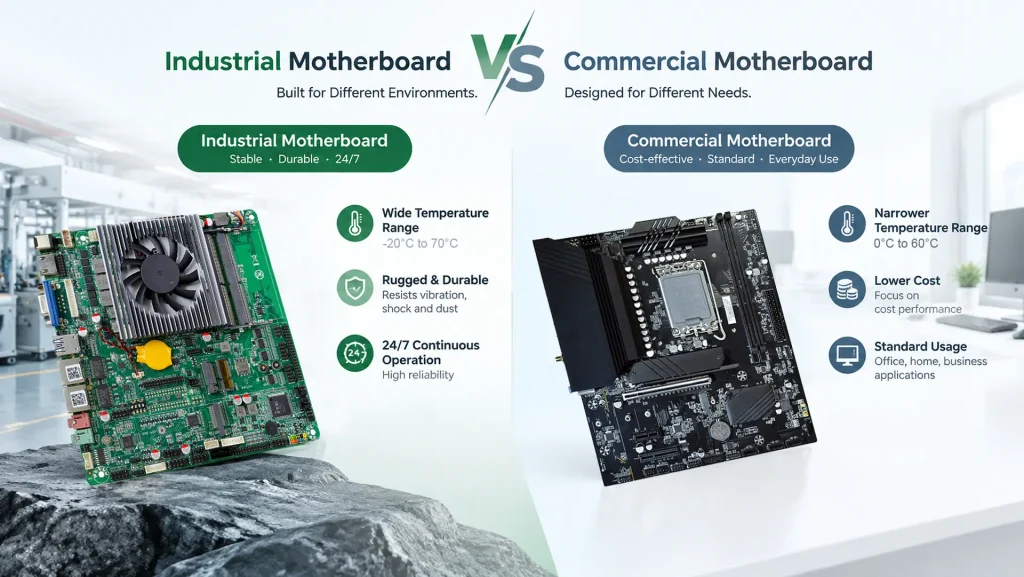
Many customers easily confuse commercial motherboards and industrial motherboards when purchasing mini PCs and all-in-one PC boards. Although they may look similar and adopt Intel or AMD platforms, they differ greatly in design goals, component quality, stability, working environment and service life, and cannot replace each other.
🏢 1. Core Design Intent & Target Deployment
Commercial Motherboard
It targets consumer and commercial scenarios such as office computers, retail POS machines, home PCs and regular commercial mini PCs. It balances performance, cost and appearance. It is designed for around 8 hours of daily operation under normal room temperature, with intermittent use on working days. Occasional restart or standby is acceptable.
Industrial Motherboard
It is built for industrial automation, embedded systems, machine vision, turnstiles, industrial all-in-one computers and on-board devices. The top priority is reliable 7×24-hour continuous operation. Stability, anti-interference capability and long-term supply consistency matter more than peak performance. Unexpected downtime may lead to production halt and data loss.
🔬 2. Component Grading & Electrical Circuit Architecture
Component Selection
- Commercial motherboards use consumer-grade components with cost priority. Ordinary electrolytic capacitors degrade rapidly under high temperature.
- Industrial motherboards adopt wide-temperature, high-grade solid capacitors and higher-spec components with larger parameter margin, stronger resistance to voltage fluctuation.
Power Supply
- Commercial power circuits are simplified for stable city power. Minor voltage fluctuation may cause blue screen or power failure.
- Industrial versions integrate over-voltage, over-current and surge protection. Wide DC input (9~36V) is commonly supported for unstable power supply in workshops and construction sites.
PCB Protection
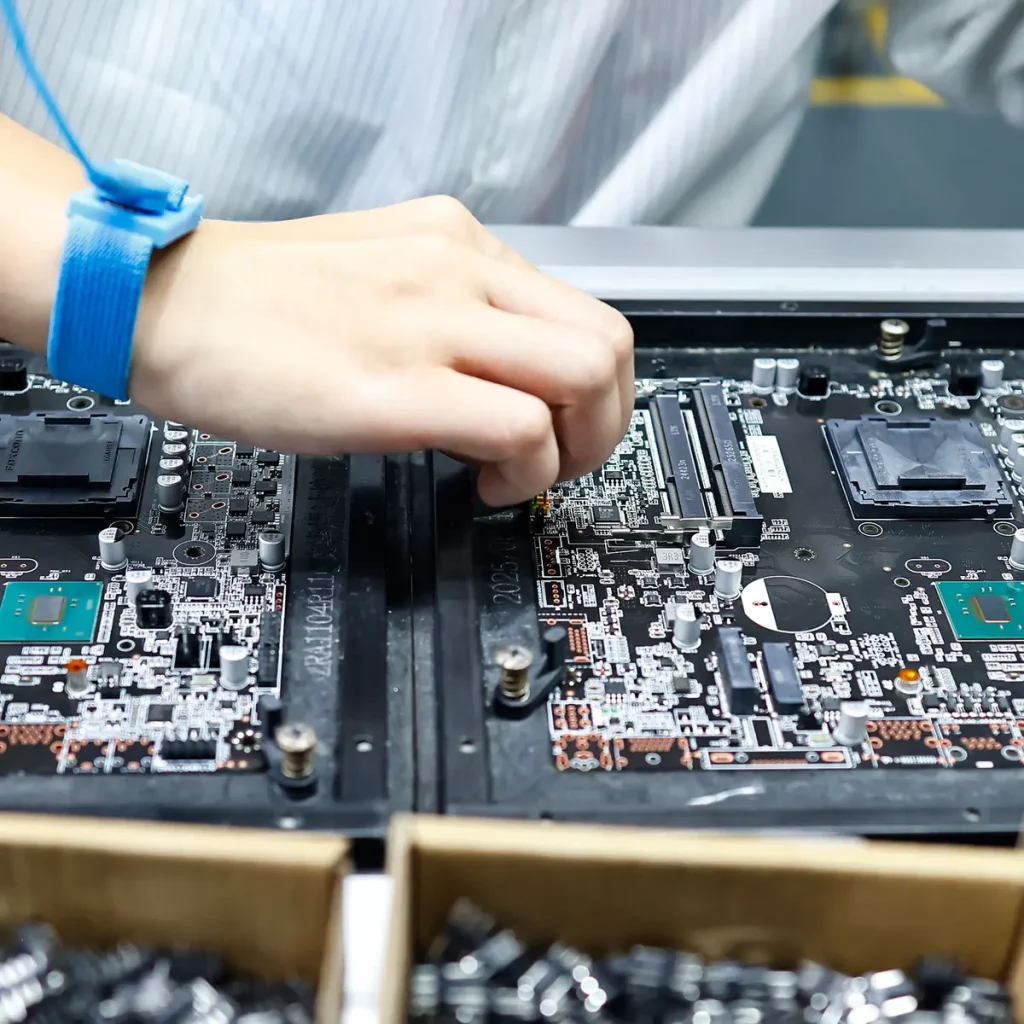
- Most industrial PCBs are thicker and coated with conformal coating for moisture, mildew and salt spray resistance.
- Commercial motherboards normally have no coating.
🛡️3. Operating Temperature Range
Commercial Range (0°C to 60°C):
Operating in unventilated enclosures or outdoor environments during peak summer will trigger rapid thermal throttling, firmware lockups, or permanent silicon damage. They cannot cold-boot below freezing points.
Industrial Range (-20°C to 70°C):
Standard wide-temperature variants run flawlessly between -20°C and 70°C, while premium rugged builds operate in deep extremes from -40°C up to 85°C. They are fully qualified for deep-freeze storage facilities, hot metal foundries, and open-air infrastructure.
⚡ 4. Interfaces, Expansion & Stability Features
Commercial Motherboard
Standard interfaces including USB and HDMI for daily use. Equipped with regular consumer Gigabit Ethernet, vulnerable to static electricity and surge. Limited BIOS options, no watchdog or hardware reset function.
Industrial Motherboard
- Watchdog timer: Auto reboot when the system freezes, essential for unattended devices
- RS232 / RS485, GPIO available to connect sensors and PLC
- Isolated lightning-protected LAN ports, dual LAN for link backup
- Rich BIOS settings: Power-on boot, scheduled startup, sleep disable, hardware monitoring
- Optimized for permanent power-on operation without relying on sleep mode
🏁 5. Product Lifecycle & Supply Continuity
Commercial motherboard:
Short lifecycle, roughly 6–12 months. Platforms update fast. It is hard to source identical boards after half a year, risky for mass production and follow-up orders.
Industrial motherboard:
Long lifecycle 3–7 years. Manufacturers guarantee long-term stable supply and unchanged revision, convenient for standardized mass production and after-sales maintenance of equipment. This is the core reason automation manufacturers choose industrial boards.
📋 6. Performance, Noise & Thermal Design
Commercial motherboards are tuned for full performance burst. Flexible cooling solutions, fanless compact designs are available for office and commercial use.
Industrial motherboards are conservative on performance release to prioritize thermal stability. Overclocking is not allowed. Fanless passive cooling is widely adopted to avoid downtime caused by fan failure. Under the same CPU, sustained performance is restrained.
📊 7. Cost Analysis & Budget Allocation
With the same chipset, industrial motherboards cost significantly higher. Extra cost comes from component redundancy, wide-temperature validation, long-term stocking and strict testing.
Using an industrial motherboard for regular office or retail devices is a waste of budget. Using a commercial motherboard for 7×24 unattended equipment will lead to frequent breakdowns and huge after-sales costs.
✅8. Suitable Application Scenarios
Commercial Motherboard:
Office PCs, commercial mini PCs, POS cash registers, exhibition all-in-one, home computers, store display units (limited daily running hours, stable environment)
Industrial Motherboard:
Production line industrial computers, machine vision, turnstiles, self-service terminals, on-board devices, outdoor monitoring, cold storage equipment, automation instruments requiring non-stop 7×24 operation
🛠️ 9. Industrial vs Commercial Motherboard: Quick Summary
Commercial motherboard: Cost-effective, works well in stable environment for scheduled daily use.
Industrial motherboard: Robust and reliable, capable of running around the clock in harsh conditions with long-term stable supply.
Contact Us For Bulk Wholesale & OEM Quotes:
Ready to expand your product catalog or secure hardware for your next large-scale project? We offer competitive volume discounts and dedicated technical support.
Shenzhen Sy Smartlink Technology Co., Ltd.
Computer Hardware OEM/ODM Manufacturer
Email: info@sysmartlink.com
Web: www.sysmartlink.com
WhatsApp: +86 15766788939
Tel: +86 15766988939
Click here to get the inquiry form, and we will reply to you within 24 hours.